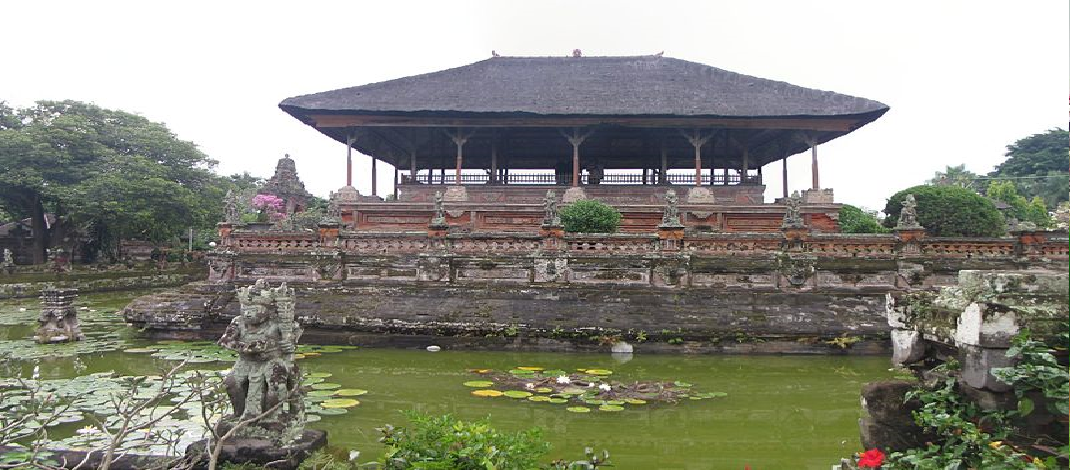
The Klungkung Palace is a historical building complex situated in Semarapura, the capital of the Klungkung regency on Bali. The palace (puri) was erected at the end of the 17th century, but largely destroyed during the Dutch colonial conquest in 1908. Today the basic remains of the palace are the court of justice, the Kertha Gosa Pavilion , and the main gate that bears the date Saka 1622 (AD 1700). Within the old palace compound is also a floating pavilion, Bale Kambing, which was added in the 1940s. The descendants of the rajas that once ruled Klungkung today live in Puri Agung, a residence to the west of the old palace, which was built after 1929.
The city was known at that time for its arts, painting, dance and music. At the end of the 18th century, the Kertha Gosa Pavilion, the hall of justice, was erected in the north-eastern corner of the palace compound. It typified the Klungkung style of architecture and painting. Kertha Gosa was considered the supreme court of Bali, and cases on the island which could not be resolved were transferred to this site. Three Brahmana priests presided over the court and were known for their harsh and inhumane sentences. The convicts (as well as visitors today) were able to view the ceiling which depicted different punishments while they were awaiting sentencing. The paintings of Puri Kertha Gosa are one of the outstanding examples of theKamasan (or Wayang) style.