Thimphu is the capital of Bhutan with area of 2,067sq.km, and also the name of the surrounding valley and dzongkhag, the Thimphu District. With a population of 104,214(2010), it is also Bhutan’s largest city, altitude of 2320m/7656ft.Thimphu became a town in 1961 and grew as the capital of Bhutan. Before 1960, Thimphu was a small settlement but was developed by the King Jigme Dorje Wangchuk to replace the ancient capital of Punakha.Today the city sprawls across the western slopes of the Wang Chuu river valley, with several government offices located around Tashichoe dzong.Rapid expansion following the pattern of rural exodus has resulted in considerable rebuilding in the city centre and mushrooming suburban development elsewhere.
Thimphu, as the political and economic centre of Bhutan, has a dominant agricultural and livestock base, which contributes to 45% of the country’s GNP.Tourism, though a contributor to the economy, is strictly regulated, maintaining a balance between the traditional and development and modernization. Thimphu contains most of the important political buildings in Bhutan, including the National Assembly of the newly formed parliamentary democracy and Dechencholing Palace, the official residence of the King, located to the north of the city.
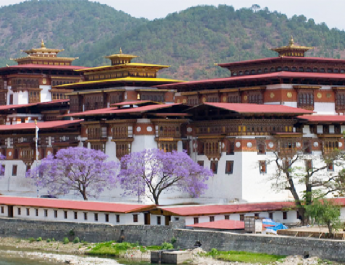
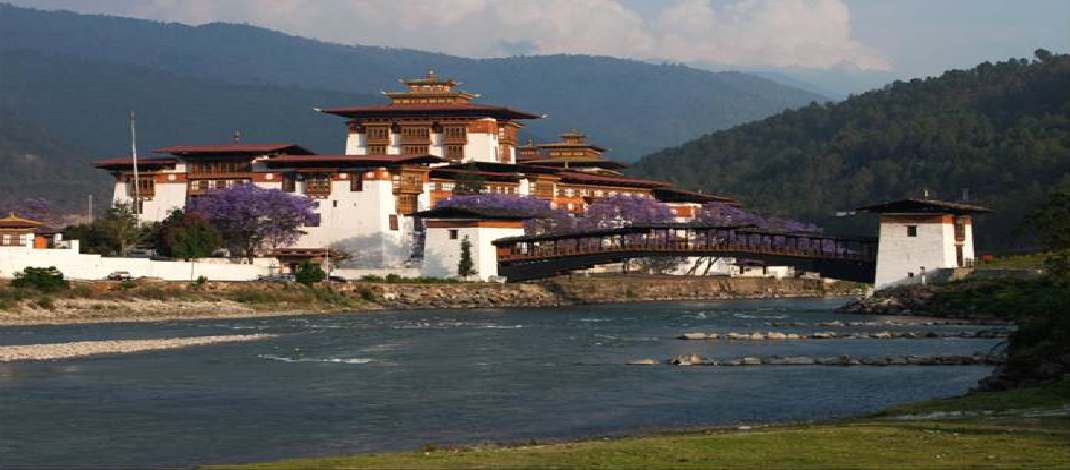
The traditional architectural monuments in Thimphu, as in the rest of Bhutan, are of typical Bhutanese architecture of monasteries, dzongs (most striking fortress type structures), chortens, gateways, Lhakhangs, other sacred places and royal palaces, which are the most distinctive architectural forms of Bhutan. Prayer Flags, Mani Walls and Prayer Wheels present a propitious setting throughout the urban agglomerate of Thimphu.
There is a mix of apartment blocks, small family homes and family-owned stores. By regulation, all buildings are required to be designed in traditional style with Buddhist paintings and motifs. A lively weekend market near the river supplies meat, vegetables and tourist items. Most of the city’s limited light industry is located south of the main bridge. Thimphu has a growing number of commercial services and offices which provide for ever-growing local needs